

Home security first: a long-term family memory center on the QMF1 AI-NAS
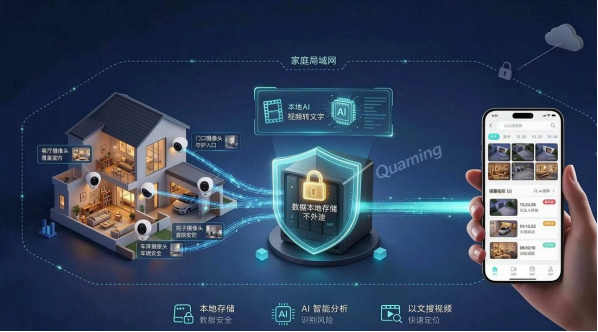
The cameras at home record all day. Phones fill up with photos, video, and medical reports. Looking for one memory, such as when a parcel was left at the door yesterday, or the beach photos from three years ago, usually means a stack of false alerts and folders named by date.
Most recordings are never opened after they land on the disk. Motion alerts are noisy, so people turn them off. Some so-called AI storage boxes either send private footage and original photos to a public-cloud model, or force a chat model onto a storage controller that does not have the compute. A search is slow, and the model can describe an event that never happened.
QuaMing is releasing a turnkey home-security AI-NAS for brand customers and ODMs. The chips are QMF1 and QMA1. The system is QuaMM, already shipping in volume. The product is not a local stand-in for a public cloud drive. It is a long-term family memory center, and home security is the front door.
The first line on screen is that the home is fine
Cameras are the only sensors in the house that keep a real record day and night. Documents might be backed up every few months. Turn the incoming video into memory that can be searched, traced, and linked, and the box has a reason to be opened every day.
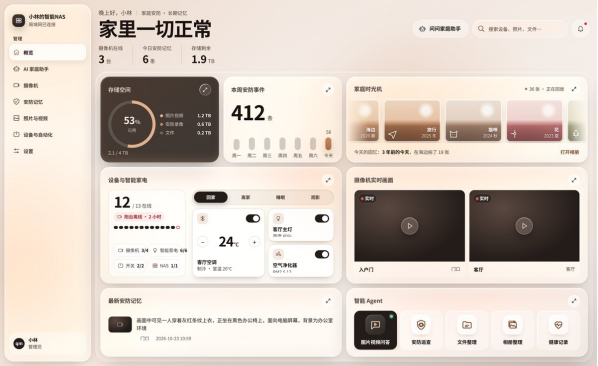
The console does not open on RAID settings or port maps. The top line says the home is fine, next to cameras online, today's security memories, and storage left. The same screen holds storage use, this week's events, a family photo river, appliances, live views, the latest security memories, and five agents.
A fast path and a slow path
Not every lookup needs a large model.
The fast path is a local structured index. It does not call a large model, and a hit is about 3 milliseconds. Cameras come in over RTSP, ONVIF, and GB28181, and third-party cameras that follow the Matter 1.5 camera standard can join. One box covers 4 to 16 channels of 1080p. As video is written to disk, the chip detects objects and writes a short sense of the frame, counts people, cats, dogs, and screens for the week, and turns that into a sentence. An example: at the door, 19:26, a courier left a box, rang the bell, and left.
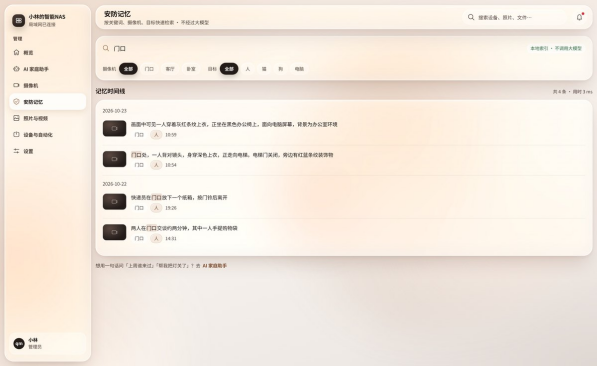
The slow path is the family assistant. Someone asks in ordinary speech, such as whether anyone came to the door yesterday afternoon, or to dim the living-room light. The on-device model, Qwen3.5-4B, first marks the intent: search security, search photos, control a light, or just talk. It then runs that module and answers in about 2 to 4 seconds. The reply can open a clip or a device switch directly.
A family photo river
The first screen has a moving strip of photos. The box can surface an older day from the local album, such as eighteen pictures at the beach on this date three years ago. Photos are grouped by person, pet, place, and screen. A sentence such as "the photo in a red dress at the beach" or "the video of the baby's first steps" finds the picture, not the filename.
Five agents
- Photo and video questions: follow-up questions about what is in a picture or a clip.
- Security review: visitors and unusual motion for the day, by time and by camera.
- Files: find contracts, receipts, and documents, with a short summary and a filing suggestion.
- Albums: group family and pets by how they look, and feed the photo river.
- Health: a private record for each person. Before comparing yearly checkups, it checks the indicator name, unit, date, and reference range, then draws that person's trend.
Appliances and four scenes
The device area uses Home Assistant, across Matter, Zigbee, and Wi-Fi. One side counts what is online and names a device that dropped off. The other switches among coming home, leaving, sleep, and watching. The same screen can set the air conditioner, the main light, the air purifier, the robot vacuum, the curtains, and the water heater. If the outside network drops, security and appliance control on the LAN still run.
Memory stays local. The phone holds the model door.
The rule is: keep family memory on the box, let the phone hold the model door, and let the user decide how data is used.
- The NAS is the only store for original data and long-term memory. Multi-channel recording, local video compute, and the search index all finish inside it. The NAS has no credentials for a public-cloud model, and it does not call one.
- Only when someone on the phone asks a question that needs cloud compute does the app call out, and only inside what that person allowed. It prefers existing tags, structured fields, or a redacted summary. A cloud model cannot browse the NAS. The phone can show what was sent, and the permission can be revoked.
- Time and camera come from the device record, not from a guess. A clip that has not been analyzed is marked unanalyzed. An empty search is not explained as "this never happened."
- A model summary, a suggested category, or a health-trend note is stored as model inference, pending confirmation. It does not become a family fact on its own. If a person's identity is not supported, it stays unknown.
- Each event opens about six seconds of the original motion clip. Family can correct a label or delete it. Only after that check does it become a fact the user confirmed.
- A person's private space and the shared family space stay separate. An administrator does not get someone else's health record or private album by default. If sharing is revoked, later search and model context stop reading that material. When a recording is overwritten, the linked memory is marked as evidence expired. A clip that should stay can be locked.
QMF1 and QMA1
Doing 16 channels of live decode and analysis, a 3 millisecond local index, on-device intent, and appliance control together, at a quiet desktop power budget, is not a storage controller with extra parts hung on it. QMF1, QMA1, and QuaMM are built as one stack.
QMF1 is the main controller for a home or a light commercial AI-NAS. It has 20 TOPS at INT8, and 5 TFLOPS at FP16/BF16. Memory is up to 16 GB of LPDDR4 or LPDDR4X at 4266 Mbps. On the device it can run models in the 3B to 7B range, including Qwen3.5-4B and Qwen2-VL. A measured 3B language model is about 11 tokens a second, and a 7B model about 5. Video is 16 channels of 1080p at 30 frames decoded in H.264 or H.265, 10 channels encoded, and JPEG at 2400 megapixels a second. Interfaces include two SATA 3.0 ports, PCIe Gen3, two USB 3.0 ports, two gigabit Ethernet ports, HDMI 2.0 at 4K60, plus AES, DES, SM4, SHA, and TrustZone. One controller can build a two-bay or larger NAS without an extra bridge chip.
QMA1 is 12 nm, for a flagship small server or a cascaded design. It has 40 TOPS at INT8 and 20 TFLOPS at FP16/BF16. There is a Lite at 32 TOPS, and QMAL as two chips together. Video is 32 channels of 1080p at 25 frames decoded, and 12 encoded. Memory is 128-bit LPDDR4X, about 70 GB/s, up to 16 GB. PCIe is Gen3 x16. A 7B model is about 11 tokens a second, and a 13B model above 6. It fits a 4-bay to 8-bay studio or small-office server, or a PCIe accelerator card.
| QMF1 | QMA1 | |
|---|---|---|
| Role | Vision fusion, main controller for a multi-camera NAS | 12 nm dense compute, small server or accelerator |
| AI | 20 TOPS INT8, 5T FP16/BF16 | 40 TOPS INT8, 20T FP16/BF16; Lite 32T |
| Video | H.264/H.265: 16×1080p30 decode, 10× encode | H.264/H.265: 32×1080p25 decode, 12× encode |
| Memory | LPDDR4/LPDDR4X/DDR4, up to 4266 Mbps, 16 GB | LPDDR4/LPDDR4X 128-bit, about 70 GB/s, 16 GB |
| On-device models | 3B about 11 tokens/s, 7B about 5; runs Qwen3.5-4B | 7B about 11 tokens/s, 13B above 6 |
| I/O | 2×SATA 3.0, PCIe Gen3, 2×USB 3.0, 2×GbE, HDMI 2.0 4K60 | PCIe Gen3 x16, 2×GbE, eMMC 5.1, SDIO 3.0 |
| Security | AES / DES / SM4 / SHA, TrustZone | AES / DES / SM4 / SM3, RSA / ECC / DSA, TrustZone |
| Typical box | 2 to 4 bay home security NAS, AI NVR | 4 to 8 bay studio or office server, PCIe card |
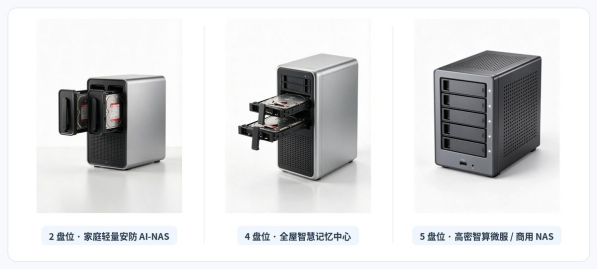
The reference designs are a 2-bay home security AI-NAS, a 4-bay whole-home memory center, and a 5-bay dense small server.
QuaMM and QuaPow
QuaMM has already shipped at the million-unit level in AIoT. The QuaPow SDK includes TPU-MLIR, which converts PyTorch, ONNX, and Caffe into QuaMing's .qmodel, with the SAIL inference library and more than 180 core operators. The factory set includes YOLO detection, RetinaFace and ArcFace, pet detection, CLIP search, and model packages such as Qwen3.5, Qwen2-VL, and DeepSeek.
The system has a local vector store, an async job queue, and a REST API. Those back the fast and slow search paths and the five agents. Remote viewing uses hardware-accelerated P2P, direct connect first. On the LAN, the connection time is within 1.0 second.
How it is delivered
QuaMing does not sell finished products to end users. What ships is the chip, a reference design with QuaMM inside, and an open module. The housing, the brand, the users, and the data stay with the customer.
- A brand with its own team takes the base system pack: QMF1 or QMA1, an evaluation board, schematic and PCB, quapow_sdk on Ubuntu Base, quapow-sail, quapow-media, tpu_mlir, and a Docker build environment. The interface and the product logic are theirs.
- A channel brand or ODM that needs to ship sooner takes the turnkey pack: the hardware reference and SDK, tuned .qmodel packages, Home Assistant for appliances, and the web and phone app sources, including both search paths, the photo river, the five agents, and appliance control. A partner can see a running sample in as little as two weeks.
For an evaluation board, the SDK, or a custom unit, write to qmpublic@quaming.com or call 17898864310.
Original post: Home security as the front door to a family memory center